Documentary Movie Reviews
(For optimum viewing, adjust the zoom level of your browser to 125%.)
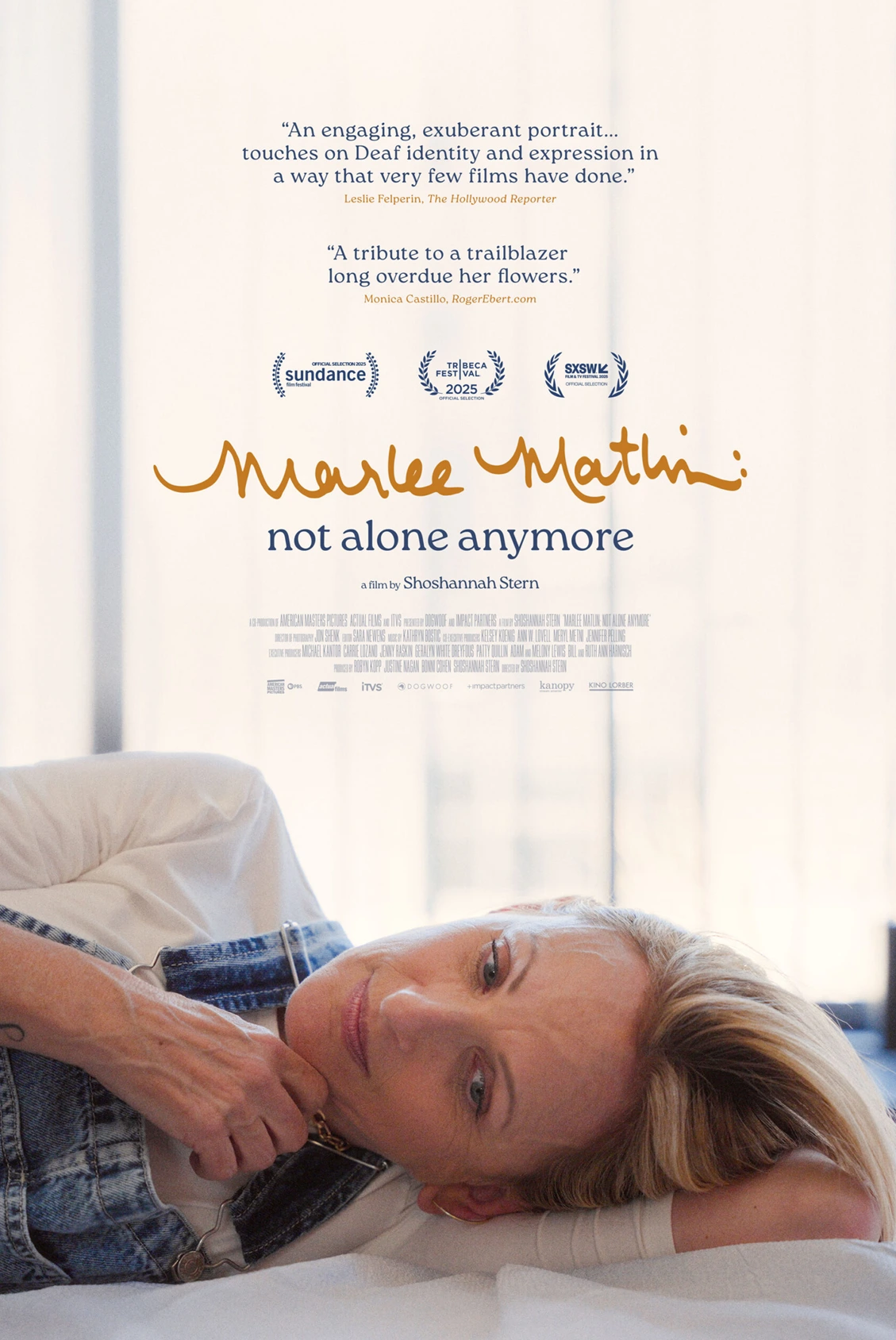
Marlee Matlin: Not Alone Anymore (2025)
Rate:
10
Viewed:
3/26
3/26:
Quick! Name a famous deaf thespian.
Marlee Matlin, of course. She was the only one during the 80's and 90's, achieving a significant breakthrough
in Children of a Lesser God and then occasionally popping up
in movies and TV shows. Most of the time, she played a stereotypical deaf character for the effect of "her
signing looks so cool!"
To be honest with you, I didn't like Children of a Lesser God
because it was so flawed and agreed that the Oscar win for Marlee Matlin (who's not born profoundly deaf which
makes a world of difference) was purely based on sympathy. Her performance was merely above average. However,
she did an excellent job in It's My Party and
Seinfeld which was one of the greatest episodes ever.
An autobiography called I'll Scream Later came out in 2009, and the most noteworthy detail was the
abusive relationship between Marlee Matlin and William Hurt, shocking everybody because no one thought of
the esteemed actor that way. Therefore, I wanted to see if she would talk more about it and anything else in
her recently released documentary: Marlee Matlin: Not Alone Anymore.
Overall, it's really hard for hearing viewers to understand what a deaf person like Marlee Matlin had to
go through. Being beautiful is never enough to overcome the barriers in life they take for granted.
The Americans with Disabilities Act (ADA) of 1990 is a failure. One easy way to look at how that is is somebody
sending her resume to a law firm and the name at the top reads "Dase'Queshea Eboigbe," resulting in an
outright rejection.
I never knew that Henry Winkler was such a great friend of Marlee Matlin's, having known her before she became
famous. Also, I was curious if she considered herself as part of the deaf world, and the answer is no. I
felt gratified to hear her say, "I was terrified of the deaf community. Petrified. And I still am. I still am."
That's because it's among the most toxic subcultures ever. They just hate anyone who speaks and is either
orally educated or cochlear implanted and are always threatened by educated deaf people who know a great
deal about the hearing world and can speak and write fluent English.
On the subject of closed captions, that's a biggie. We take them for granted today, but back then, it was
very, very hard to find anything much on TV that was closed captioned. Ditto for VHS tapes. One had to buy a
closed caption decoder because the TV didn't have one and needed to figure out how to connect all of them along
with the VCR player. Eventually, a law was passed requiring all televisions to be so. Ironically, Kino Lorber,
the financer of the documentary, is quite infamous for having zero, zero, zero closed captions on all of its
very-hard-to-find movies, and not many are even subtitled.
Unfortunately, there are a couple of missed opportunities for Marlee Matlin to talk about. I wanted to know what
kind of education she received in the 60's and 70's, how she got started with signing and speaking, and what
the makeup of her classmates was in terms of hearing ability at various points. Another is the impressive job
by some actors using ASL in the presence of Marlee Matlin such as William Hurt in
Children of a Lesser God, Ed Harris in
Walker, Eric Roberts in It's My Party,
and Mark Harmon in Reasonable Doubts. How long did it take them to acquire the language and then be so
fluent-looking?
All in all, Marlee Matlin: Not Alone Anymore is fascinating.